
See it work
Real screenshots from a running instance — demo data, no mockups.
1 · Collect knowledge
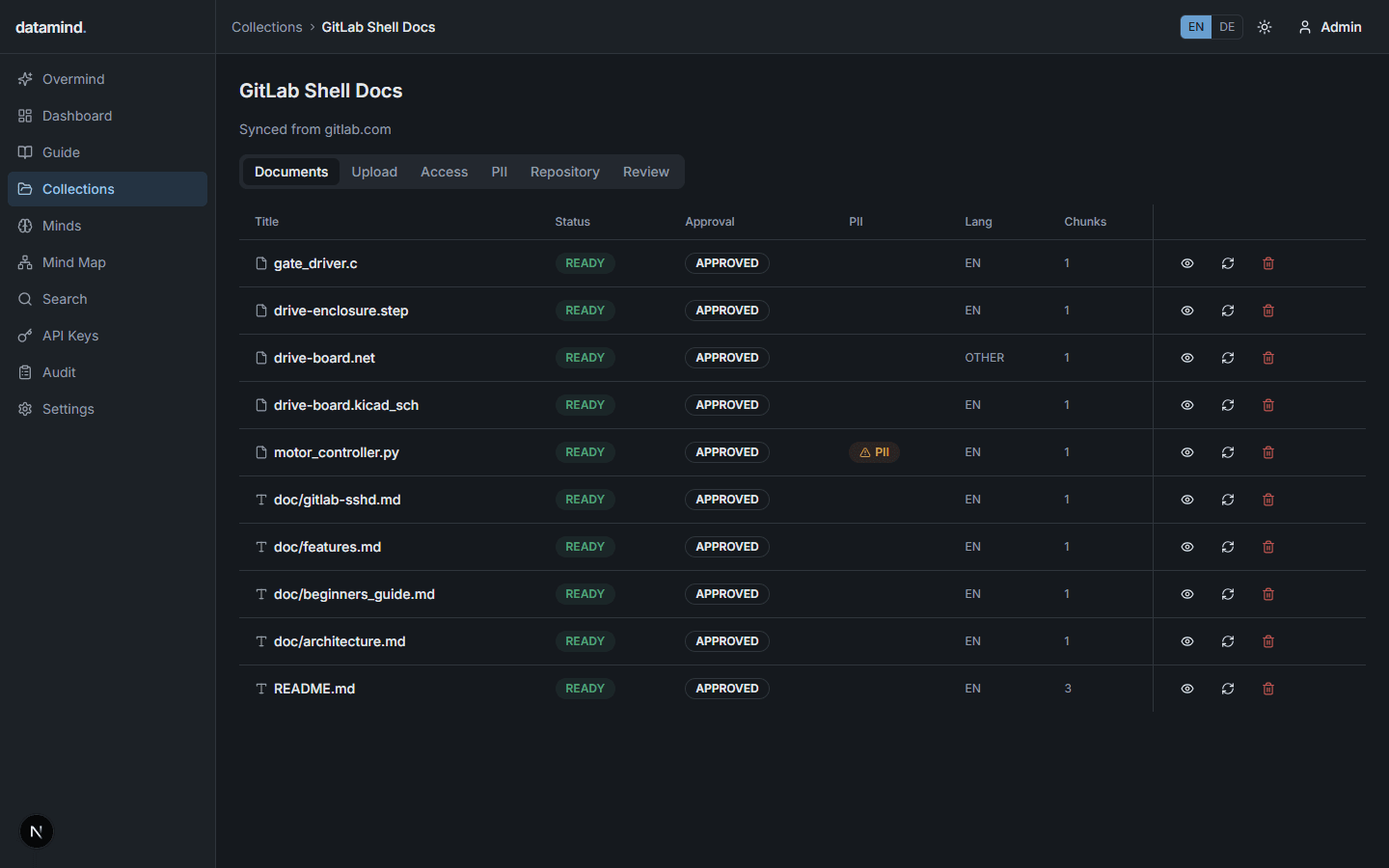
Upload documents or connect a GitLab repository that stays in sync on every push. Each file is parsed, checked for personal data, and approved before it becomes knowledge — the status of every document is always visible.
2 · Ask in plain language
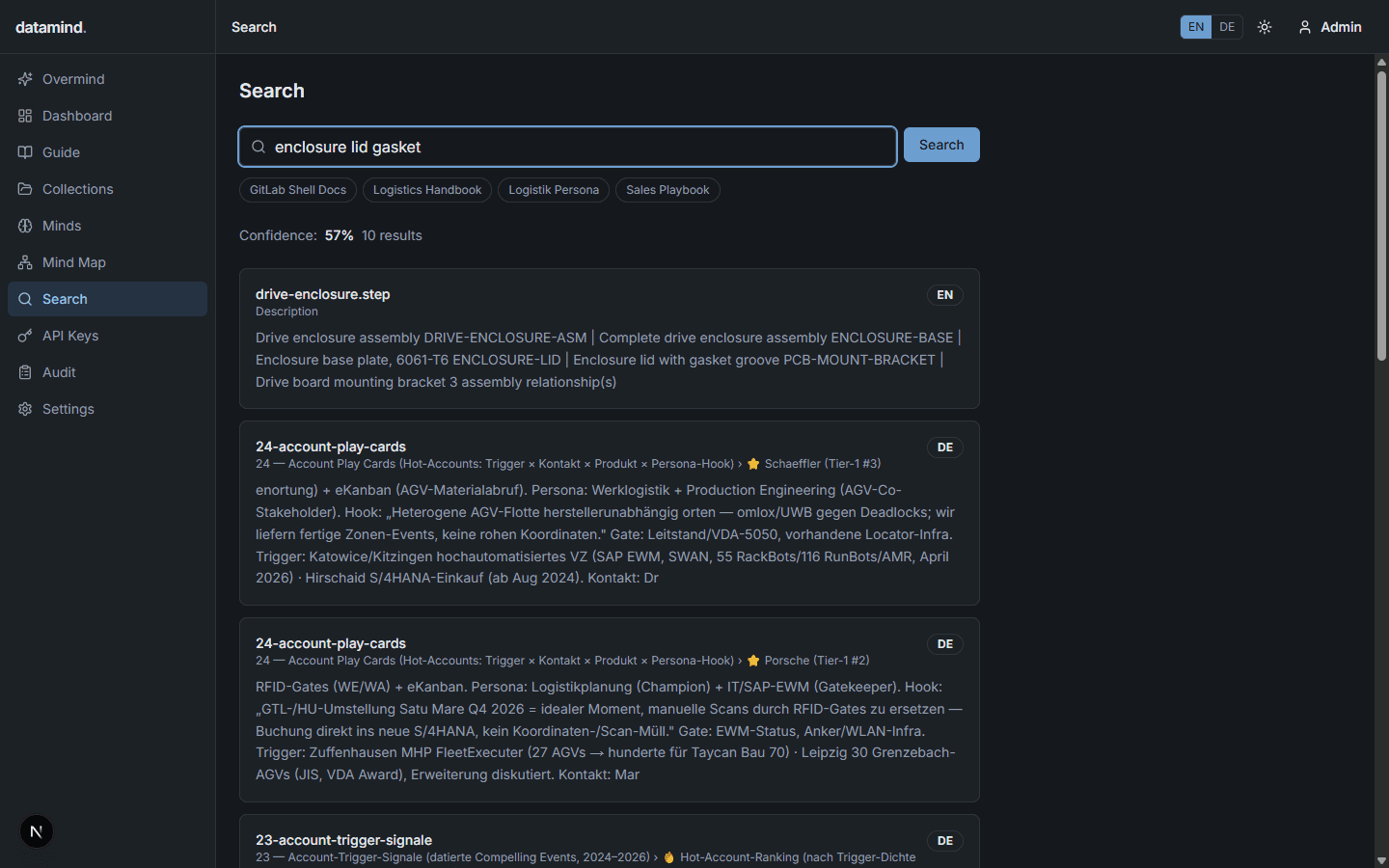
Search finds passages by meaning, not keywords — a question about a gasket finds the CAD assembly even though the file never says "gasket groove" the way you do. Minds turn the same retrieval into written, cited answers with a confidence gate.
3 · Review & measure
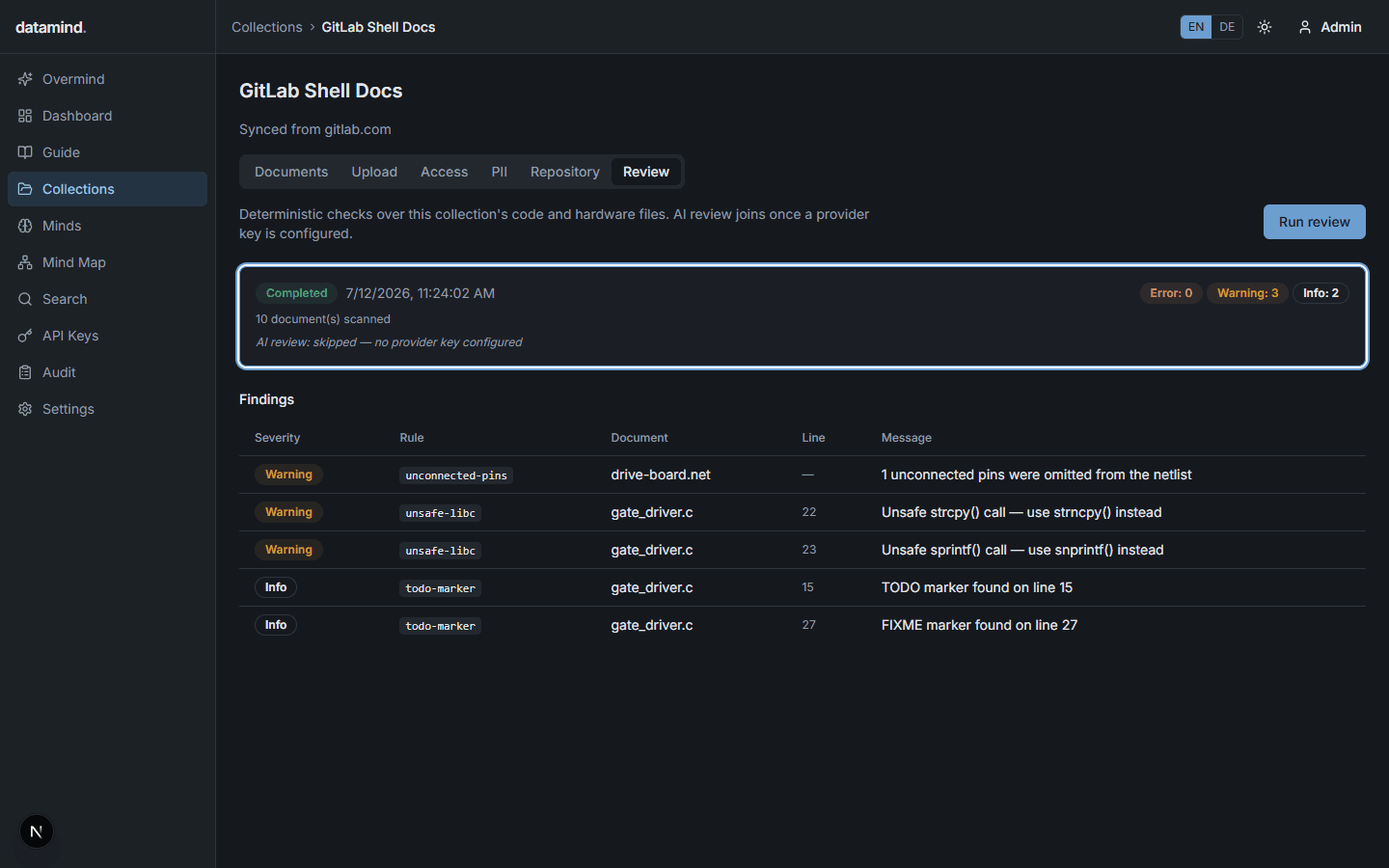
One click scans a whole collection: unsafe code patterns, forgotten TODOs, unconnected pins on a board — each finding with severity, rule and line number. Expert quality is tracked as a health score from automated evaluations.
Why it matters
Teams lose hours hunting through wikis, folders and old email threads — or worse, they act on answers a public chatbot made up. Datamind gives you a single place to ask, with answers you can verify and permissions you can trust.
Every claim is cited
Answers carry footnotes linking to the exact document and section. Verification is one click, not an afternoon.
It says "I don't know"
When the sources don't support an answer, the expert declines and explains why — instead of inventing something plausible.
Your knowledge stays yours
Self-hosted on your servers. Access rights are enforced on every single answer, and every action lands in an audit log.

Feature comparison at a glance
| Capability | Public chatbots | Wiki & file search | Cloud copilots | Datamind |
|---|---|---|---|---|
| Written answers, not just links | ||||
| Sources cited on every claim | ||||
| Refuses instead of guessing | ||||
| Your access rights on every answer | ||||
| Data stays on your servers | ||||
| Answer quality measured per expert |
YesPartly / dependsNo
Built for engineering teams too
Datamind is not limited to office documents. It keeps source code in sync straight from GitLab, reads KiCad schematics, netlists and 3D-CAD part lists, and runs automated reviews over all of it.
- Source code stays in sync with your repository and is chunked by function, so answers cite the exact routine.
- Schematics become searchable component and net lists — ask which microcontroller a board uses and get a cited answer.
- One-click review runs flag unsafe code patterns, forgotten TODOs and unconnected pins — findings become citable knowledge.

For IT: built to be operated
A boring deployment in the best sense — containers, one reverse proxy, one database.
Self-hosted
Docker Compose behind Traefik with automatic TLS; only ports 80 and 443 exposed. PostgreSQL is the only stateful service.
Roles & access
Role-based permissions plus per-collection access levels, enforced at query time on every answer — not just in the UI.
Audit & observability
Append-only audit log, structured JSON logs with correlation IDs, health endpoints and metrics out of the box.
AI providers, your choice
Google Gemini, OpenAI, Anthropic or a local OpenAI-compatible model. Keys are entered by an admin and stored encrypted — never in code or config files.
APIs included
A versioned REST API with scoped API keys, plus an MCP server so other AI tools and agents can query your knowledge with the same permission checks.
Bilingual by design
The entire product speaks English and German — including cross-language search: ask in German, find the English document.
Frequently asked questions
Where does our data live?
On your own servers. Datamind ships as Docker containers behind your reverse proxy; documents, passages and chat history are stored in your PostgreSQL database. Only the text needed to answer a question is sent to the AI provider you configure — and with a local model, nothing leaves your network at all.
Which AI models can we use?
Google Gemini, OpenAI, Anthropic Claude, or any local OpenAI-compatible server (Ollama, vLLM, LM Studio). An admin enters the key once in Settings — encrypted at rest — and each expert can use a different model, so you can mix a strong cloud model for hard questions with a local one for routine ones.
Can it answer with something we're not allowed to see?
No. Access rights are checked at answer time, per passage: an expert can only cite documents from collections the asking person has been granted. The same rule applies to API keys and connected AI tools.
What does it cost to run?
The platform itself is your infrastructure — one host with Docker is enough to start. AI usage is pay-per-use with your own provider key; typical question-and-answer interactions cost cents. There are no per-seat AI licences.
What if it doesn't know the answer?
It says so. Every expert has a confidence threshold: when the best matching passages are too weak, it refuses and explains why, instead of producing a plausible guess. You can tune the threshold per expert and measure quality with built-in evaluations.
Does it work in German?
Yes — the entire interface is English and German, and search is cross-language: a German question finds the English document and vice versa. Answers cite the source either way.
Ready? Sign in and ask your first question.
Sign in